
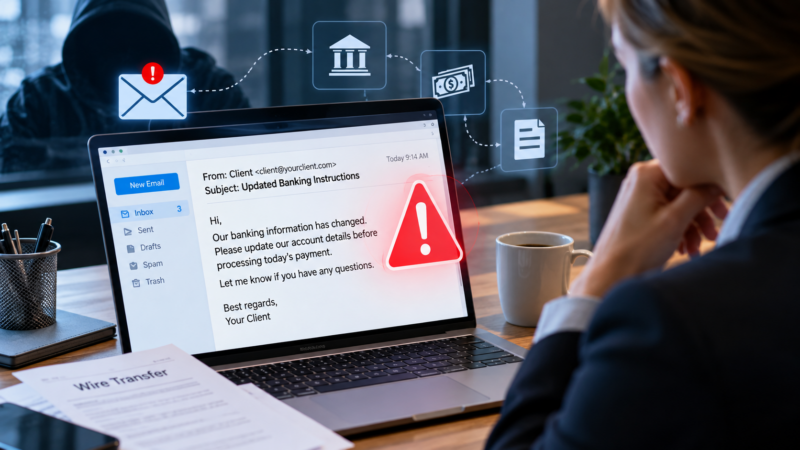
A financial services employee receives an email that appears to come from a trusted client.
The message explains that the client’s banking instructions have changed and asks the employee to update the account information before processing a payment.
The name looks familiar. The email references an active transaction. The tone sounds professional.
Nothing immediately appears suspicious.
But the message is fraudulent.
If the employee follows the instructions without independent verification, the money could be sent to an account controlled by a criminal.
This is one example of business email compromise (BEC), a form of cyber-enabled fraud that uses email accounts, impersonation, and social engineering to manipulate employees into transferring money, disclosing information, or changing business processes.
For financial services firms, the consequences can be particularly serious.
Financial advisors, wealth management companies, accounting firms, mortgage lenders, insurance agencies, and other financial organizations routinely handle confidential information, payment instructions, and time-sensitive client requests.
Criminals understand these workflows.
They do not always need to deploy ransomware or break through a firewall. Sometimes, they only need one convincing message delivered at the right moment.
Business email compromise is not simply an email problem. It is a financial fraud, identity security, and business process risk.
What Is Business Email Compromise?
Business email compromise is a type of fraud in which an attacker uses email-based deception to persuade someone to take an unauthorized action.
That action might involve:
- Sending a wire transfer to a fraudulent account
- Changing a vendor’s banking information
- Disclosing confidential client records
- Sharing employee or customer information
- Purchasing gift cards or other items
- Redirecting payments
- Approving an unauthorized financial transaction
- Providing access to internal systems
Attackers may impersonate an executive, client, employee, vendor, or other trusted contact.
In some cases, they create a lookalike email address. In others, they gain access to a legitimate mailbox and send messages from the real account.
That distinction matters.
An employee may be trained to identify obvious phishing emails, but a fraudulent message sent from a compromised account can look considerably more credible.
Business Email Compromise vs. Phishing
Phishing is a broad category of deceptive communications intended to trick recipients into revealing information, opening malicious content, or taking harmful actions.
Business email compromise is more specific.
BEC commonly focuses on impersonation and the manipulation of financial or business workflows.
A traditional phishing email might direct someone to a fake login page.
Both are security threats, but preventing them requires more than the same basic spam filter.
Financial services firms need a combination of email security, identity protection, employee awareness, and transaction verification procedures.
Why Financial Services Firms Are Attractive Targets
Financial organizations operate in environments where trust, confidentiality, and timely communication are essential.
Employees routinely receive instructions involving accounts, documents, approvals, and money.
Attackers can exploit those ordinary activities.
Financial Transactions Are Part of Daily Operations
Financial firms may coordinate client transfers, invoice payments, investment-related instructions, loan disbursements, or other financial activities.
An attacker who successfully impersonates an authorized party may attempt to redirect those transactions.
Employees Handle Sensitive Client Information
Financial organizations may maintain account details, identification documents, tax information, financial statements, and other confidential records.
A fraudulent email requesting information can create a privacy and security incident even when no money changes hands.
Many Transactions Are Time-Sensitive
Criminals frequently create urgency.
A message might claim that a closing is delayed, a client is waiting, an invoice is overdue, or an executive needs an immediate response.
Time pressure can discourage employees from following normal verification procedures.
Financial Firms Depend on External Relationships
Accountants, lenders, advisors, insurance professionals, and other financial services employees communicate with numerous outside parties.
Attackers may exploit these relationships by impersonating a known client, service provider, or professional contact.
Smaller Firms May Have Less Formal Verification Procedures
A smaller financial services business may rely heavily on personal relationships and informal approval processes.
That can create a false sense of security.
Knowing a client personally does not prove that an email claiming to come from that client is authentic.
Five Common Business Email Compromise Attacks
Understanding the most common attack patterns can help employees recognize suspicious requests before money or information is lost.
1. Executive Impersonation
An employee receives an email appearing to come from the company’s owner, CEO, CFO, or another senior leader.
The message requests an urgent payment or confidential information.
For example:
“Please process this transfer before the end of the day. I’m unavailable by phone, so just confirm by email.”
The attacker relies on authority and urgency.
Employees may feel uncomfortable questioning a senior executive, particularly when the message appears to involve an important business matter.
Prevention: Require established approval procedures for financial transactions, regardless of the apparent sender’s position.
2. Vendor Payment Redirection
A business receives a message that appears to come from a familiar supplier.
The message says the vendor has changed banks and provides updated payment details.
If the accounting team changes the payment destination without independently confirming the request, future payments may be redirected to a criminal account.
Prevention: Verify banking changes using a previously established contact method, not the phone number or link provided in the email requesting the change.
3. Client Account Impersonation
A financial advisor or other professional receives an apparent request from a client.
The message may ask for account changes, document transfers, or payment instructions.
The criminal may use a similar-looking email address or a compromised client account.
Prevention: Use approved identity verification and transaction authorization procedures for sensitive requests.
4. Compromised Email Account Fraud
An attacker obtains access to a legitimate business mailbox.
They may review previous conversations, identify upcoming payments, and wait for an opportunity to insert fraudulent instructions into an existing email thread.
Because the email comes from a real account and may reference genuine business details, the request can be difficult to identify through appearance alone.
Prevention: Protect accounts with strong authentication, monitor suspicious sign-ins, and verify sensitive instructions outside email.
5. Mortgage and Closing-Related Wire Fraud
Mortgage lenders, title-related businesses, real estate professionals, and their clients may exchange time-sensitive information during a closing.
Attackers may impersonate a party to the transaction and send fraudulent wire instructions.
A message that appears to provide a last-minute banking update can be especially dangerous.
Prevention: Establish clear instructions in advance about how payment details will be communicated and verified. Treat unexpected changes as high-risk events.
How Attackers Make Fraudulent Emails Look Legitimate
Business email compromise often succeeds because criminals exploit context rather than relying on obviously suspicious language.
Lookalike Domains
An attacker may register an email domain that resembles a legitimate company’s domain.
A single changed letter, added word, or different domain ending can be easy to overlook.
Employees should not rely solely on the sender’s display name.
Familiar Email Threads
A compromised account may allow an attacker to respond within an existing conversation.
That creates the appearance of continuity.
The employee may recognize the participants and subject line without realizing the account is being misused.
Real Business Details
Attackers may reference actual invoices, projects, transactions, names, or deadlines.
These details make a fraudulent request more believable.
Artificial Urgency
Messages may emphasize immediate action:
“The transfer must be completed today.”
“The client is waiting.”
“Do not delay the payment.”
Urgency should not override verification requirements.
Secrecy and Authority
Some messages tell employees not to involve colleagues or claim that a transaction is confidential.
That is especially concerning when it conflicts with established approval procedures.
Why Email Security Software Alone Is Not Enough
But no email filtering technology can reliably determine whether every payment instruction is authorized.
Consider a fraudulent message that contains no malware, no suspicious link, and no attachment.
It simply asks an employee to update banking information.
Even if the message reaches the inbox, the organization should still have a process that prevents an unverified change from becoming an unauthorized payment.
That is why effective BEC prevention requires multiple layers.
Technology helps identify and contain threats. Business procedures help prevent deceptive instructions from becoming financial losses.
Eight Controls That Help Prevent Business Email Compromise
1. Require Multi-Factor Authentication
Multi-factor authentication (MFA) requires an additional form of verification when accessing an account.
It can make it harder for attackers to access a mailbox using a stolen password.
For sensitive accounts, phishing-resistant MFA methods may provide stronger protection against certain credential theft techniques.
Financial firms should pay particular attention to email administrators, executives, finance personnel, and employees with access to confidential information.
MFA is an important defense, but it does not eliminate every account compromise or impersonation risk.
2. Strengthen Email Authentication
Organizations should evaluate email authentication technologies such as:
SPF — Sender Policy Framework: Helps identify systems authorized to send email for a domain.
DKIM — DomainKeys Identified Mail: Uses cryptographic signatures to help verify message integrity and domain association.
DMARC — Domain-based Message Authentication, Reporting and Conformance:
Helps domain owners define how receiving systems should handle certain messages that fail authentication checks and provides reporting capabilities.
Proper configuration can help reduce some forms of domain spoofing.
However, these technologies do not stop every fraudulent message, particularly when criminals use lookalike domains or compromised legitimate accounts.
3. Establish Independent Payment Verification
Financial firms should never rely solely on an email to approve changes to sensitive payment instructions.
Use a previously verified phone number, secure client portal, or another approved independent method to confirm:
- New wire instructions
- Changes to beneficiary accounts
- Vendor banking updates
- Unusual transfer requests
- Requests involving sensitive account information
The verification channel must be independent of the suspicious request.
Calling a phone number included in the fraudulent email may simply connect the employee to the attacker.
4. Separate Transaction Responsibilities
For higher-risk transactions, consider requiring more than one authorized employee to participate in approval.
One person might initiate a change while another independently reviews and approves it.
This separation of duties can reduce the risk of a single deceptive message resulting in an unauthorized transfer.
The process should match the organization’s size, transaction types, and risk exposure.
5. Monitor for Suspicious Account Activity
Potential warning signs of email account compromise include:
- Unusual sign-in locations
- Unexpected mailbox forwarding rules
- Suspicious changes to account settings
- Unauthorized access attempts
- Unfamiliar applications connected to accounts
- Unexpected messages sent from employee mailboxes
Appropriate logging, monitoring, and alerting can help security teams investigate suspicious behavior.
6. Train Employees Using Realistic Scenarios
Generic cybersecurity training may not adequately prepare employees for a convincing financial fraud attempt.
Training should include situations employees could realistically encounter.
For example:
An advisor receives updated payment instructions from a familiar client.
An accounting employee receives a banking change request from a supplier.
A mortgage professional receives an urgent request during a closing.
A finance manager receives an unusual message from an executive.
Employees should know which requests require verification, how to report suspicious activity, and that following established controls takes priority over responding quickly.
7. Limit Account Privileges
Not every employee needs access to every financial system or sensitive record.
Applying least-privilege access can help reduce the potential impact of a compromised account.
Organizations should periodically review access rights, especially following role changes and employee departures.
8. Prepare an Incident Response Plan
Even with strong safeguards, suspicious requests and account compromises may occur.
Financial firms should have a documented response process that identifies who investigates, who makes decisions, and who communicates with relevant parties.
A plan can help reduce confusion during a time-sensitive incident.
What to Do If Your Firm Suspects Business Email Compromise
If an employee identifies a suspicious payment request or potential account compromise, speed and coordination matter.
Stop the Transaction When Possible
Do not process a suspicious payment while verification is incomplete.
If funds have already been transferred, immediately contact the financial institution involved and request assistance with potential recall or recovery procedures.
Notify the Appropriate Internal Team
Employees should know how to contact IT, security, leadership, and other designated responders.
Do not rely on replying to a potentially compromised email thread.
Preserve Relevant Evidence
Retain suspicious messages and other relevant information in accordance with the organization’s incident response and evidence-handling procedures.
Secure Potentially Compromised Accounts
Depending on the circumstances, responders may need to reset credentials, revoke sessions, review account permissions, inspect forwarding rules, and investigate connected applications.
Determine Whether Information Was Exposed
Not every BEC incident involves a financial transfer.
Investigate whether confidential records, credentials, or other sensitive information were accessed or disclosed.
Evaluate Reporting and Notification Obligations
Applicable legal, regulatory, contractual, and insurance requirements vary by organization and incident.
Financial firms should involve appropriate legal, compliance, and insurance resources when necessary.
Review What Happened
After containment, determine whether additional safeguards, training, or approval controls are needed.
An incident should lead to improvements in both technical defenses and business procedures.
Business Email Compromise and Financial Services Compliance
The applicable requirements depend on the organization’s activities, regulatory status, and jurisdiction.
Gramm-Leach-Bliley Act
The Gramm-Leach-Bliley Act (GLBA) forms part of the regulatory framework governing the protection of certain customer financial information.
Organizations subject to applicable safeguarding requirements should evaluate how email security, access controls, employee training, and incident response support their information security programs.
FTC Safeguards Rule
Covered financial institutions under Federal Trade Commission jurisdiction must comply with applicable requirements of the FTC Safeguards Rule.
Depending on the organization, relevant security program elements may include access controls, authentication, monitoring, training, and incident response.
SEC Regulation S-P
Certain SEC-regulated firms are subject to Regulation S-P, including applicable safeguarding and incident response obligations.
Firms should understand the amended rule’s requirements and applicable compliance dates.
NIST Cybersecurity Framework 2.0
The NIST Cybersecurity Framework offers a useful structure for organizing cybersecurity activities across governance, identification, protection, detection, response, and recovery.
Financial firms can use the framework to evaluate whether their email security and fraud prevention measures form part of a coordinated risk management program.
These frameworks do not replace transaction-specific verification controls, and this article is not legal or regulatory advice.
Why Business Continuity Matters After an Email Compromise
A business email compromise incident may affect more than one transaction.
If an attacker accesses a mailbox, the organization may need to investigate account activity, review sensitive communications, secure credentials, and evaluate whether other systems were affected.
Employees may temporarily lose access to certain accounts while the investigation takes place.
Client communication may need to move to verified alternate channels.
A business continuity plan should consider how the organization will maintain critical operations during that disruption.
Questions to address include:
- How will employees communicate if email accounts cannot be trusted?
- Who can authorize urgent transactions?
- How will clients receive verified instructions?
- Which applications and records remain available?
- Who coordinates the response?
- How will the organization return to normal operations safely?
Financial firms should plan for these situations before an incident occurs.
For additional guidance, read Matador Networks’ article:
Business Continuity for Financial Services: How to Prepare for Ransomware, Downtime and IT Disasters
Business Email Compromise Prevention for Financial Firms in McKinney and North Texas
Financial services businesses in McKinney, Plano, Frisco, Allen, Dallas, and surrounding North Texas communities rely on email, cloud applications, and digital communication to serve clients.
A financial advisory practice may coordinate confidential documents and client requests.
An accounting firm may exchange tax records and payment information.
A mortgage lender may manage time-sensitive transactions.
An insurance agency may process confidential customer information and policy-related requests.
Each organization faces different workflows, but the same underlying challenge:
How do you verify that a sensitive request is legitimate before someone acts on it?
For North Texas financial firms, cybersecurity planning should address both the technology environment and the procedures employees use every day.
That includes email protection, identity management, security monitoring, employee awareness, incident response, and business continuity.
How Matador Networks Can Help Strengthen Email Security
Its managed IT and managed security services help organizations address important technology and cybersecurity needs.
For financial services firms concerned about business email compromise, relevant areas to evaluate include:
Managed Security Services
Email security, threat monitoring, and related security controls can contribute to a layered defense against malicious activity.
Managed IT Services
Consistent account administration, software maintenance, access management, and technical support help organizations maintain a more controlled technology environment.
Security Monitoring and Incident Response Readiness
Financial firms should understand how suspicious activity is identified, investigated, and escalated.
Business Continuity and Recovery
Organizations should be prepared to continue critical operations when an account or system becomes unavailable during an investigation.
Technology Planning
Cybersecurity controls are most effective when aligned with business processes, financial risk, and operational requirements.
A review of the technology environment can help identify gaps that may otherwise remain unnoticed until an incident occurs.
Business Email Compromise Prevention Checklist
- Multi-factor authentication is required for business email accounts.
- Privileged accounts receive additional protection.
- SPF, DKIM, and DMARC configurations have been reviewed.
- Employees know how to report suspicious payment requests.
- Changes to banking instructions require independent verification.
- High-risk transactions have appropriate approval controls.
- Employees receive training on impersonation and financial fraud.
- Suspicious sign-in activity is monitored.
- Mailbox forwarding rules and account changes can be investigated.
- Access rights are reviewed periodically.
- The organization has a documented incident response process.
- Leadership knows whom to contact if funds are transferred fraudulently.
- Alternate communication methods are available during an email incident.
- Cybersecurity procedures are reviewed as business workflows change.
If several answers are uncertain, your organization may benefit from a closer review of its email security and financial transaction procedures.
Frequently Asked Questions About Business Email Compromise
Financial services leaders should be able to get clear answers to these questions:
1. What is business email compromise in financial services?
Business email compromise is a form of fraud that uses deceptive or compromised email communications to manipulate employees into transferring money, disclosing sensitive information, or taking unauthorized actions. Financial firms can be targeted through client impersonation, vendor payment changes, and executive fraud.
2. Can business email compromise happen without malware?
Yes. Many BEC attempts rely on convincing messages and social engineering rather than malicious attachments or software. This is why technical email protection should be combined with independent verification procedures.
3. How do criminals use compromised email accounts?
Attackers may access legitimate mailboxes, review business conversations, and send fraudulent requests that appear to come from trusted contacts. They may also create forwarding rules or monitor communications for opportunities to redirect payments.
4. What is executive impersonation fraud?
Executive impersonation fraud occurs when a criminal pretends to be a senior leader and requests an unauthorized payment, confidential information, or another sensitive action.
5. How can financial advisors prevent fraudulent client transfer requests?
Financial advisors should follow documented authorization procedures, independently verify sensitive instructions, protect accounts with strong authentication, and train employees to recognize unusual or urgent requests.
6. What should a company do after sending money to a fraudulent account?
Immediately contact the sending financial institution and request assistance. Notify appropriate internal responders and follow relevant incident response, reporting, and legal procedures. Rapid action may improve the possibility of recovery, but recovery is not guaranteed.
7. Does MFA prevent business email compromise?
MFA helps reduce some account takeover risks, but it does not prevent every form of BEC. Attackers may use lookalike domains, compromised third-party accounts, or other social engineering methods.
8. What are SPF, DKIM, and DMARC?
SPF, DKIM, and DMARC are email authentication technologies that help organizations and receiving mail systems evaluate whether messages are associated with authorized sending domains. They can help reduce some impersonation risks when properly configured.
9. Why is wire fraud a concern for mortgage companies?
Phishing broadly involves deceptive communications. Business email compromise typically focuses on impersonating trusted parties to manipulate business processes, especially payments and sensitive information requests.
10. Can small financial services firms be targeted?
Yes. Small organizations may handle valuable information and transactions while having fewer dedicated cybersecurity resources or less formal approval procedures.
11. How often should employees receive BEC awareness training?
Training should be ongoing and refreshed when threats, employee responsibilities, or financial workflows change. Organizations should focus on practical scenarios relevant to their operations.
12. Should financial firms verify banking changes by phone?
Independent verification using a previously established, trusted contact method is an important safeguard. Employees should not rely on contact details supplied in the message requesting the change.
13. Can managed IT services help prevent email fraud?
Managed IT and security services can support email security configuration, account protection, monitoring, technical maintenance, and incident response readiness. Financial transaction approval and verification procedures remain essential business responsibilities.
Protect Your Clients, Your Transactions, and Your Business
A convincing fraudulent email can create a costly problem for a financial services firm.
The attacker may impersonate a trusted client, compromise an employee account, or insert false payment instructions into a legitimate conversation.
Preventing these attacks requires more than telling employees to be careful.
Financial firms need effective identity security, email protection, transaction verification procedures, monitoring, and a documented response plan.
The goal is simple:
Make it harder for criminals to impersonate trusted contacts—and harder for one fraudulent message to become a financial loss.
Matador Networks helps North Texas businesses strengthen their managed IT, cybersecurity, and business continuity environments.
If your organization is unsure whether its current email security and account protections are sufficient, start with a closer look at the risks.
Schedule a Financial Services Cyber Risk Assessment
Identify potential gaps in your email security, access controls, and technology environment before a fraudulent request becomes an expensive incident.
Contact Matador Networks to discuss your cybersecurity priorities.
Cybersecurity procedures are reviewed as business workflows change.
Alternate communication methods are available during an email incident.
Leadership knows whom to contact if funds are transferred fraudulently.
The organization has a documented incident response process.
Access rights are reviewed periodically.
Mailbox forwarding rules and account changes can be investigated.
Suspicious sign-in activity is monitored.
Employees receive training on impersonation and financial fraud.
High-risk transactions have appropriate approval controls.
Changes to banking instructions require independent verification.
Employees know how to report suspicious payment requests.
SPF, DKIM, and DMARC configurations have been reviewed.
Privileged accounts receive additional protection.
Multi-factor authentication is required for business email accounts.